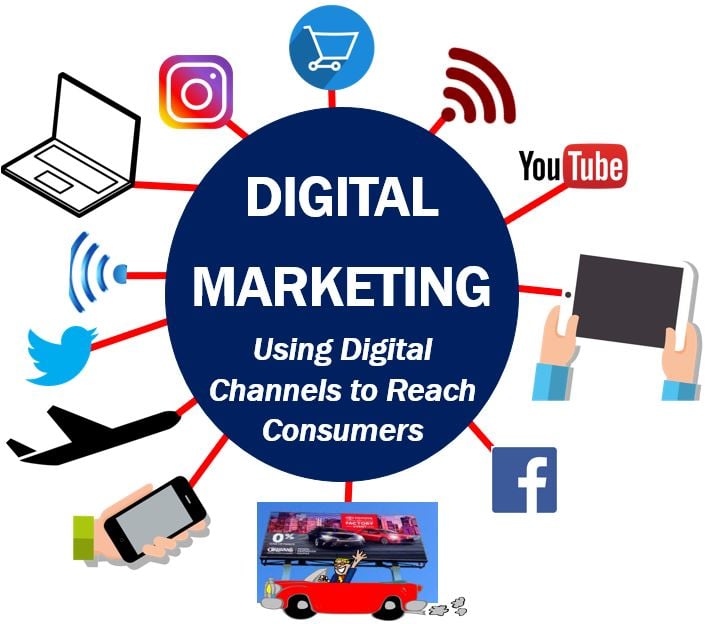
"Digital marketing is the component of marketing that utilizes internet and online based digital technologies such as desktop computers, mobile phones and other digital media and platforms to promote products and services"
Digital marketing is the marketing of goods and services via digital technologies. The Internet, for example, is a type of digital technology. However, it is not the only one. Digital marketing also includes marketing services and products using display advertising, mobile phones, and other digital media.
If you are a marketing professional today, you probably market products or services using digital channels. You probably also use traditional channels, such as printed newspapers and magazines.
For more sophisticated communication, Omnichannel marketing communication can be used, which combines various marketing channels to create seamless communication with your customer.
According to A1 SEO Glasgow, a major part of digital marketing includes these three objectives:
“Improving keyword rankings, increasing traffic, and increasing leads.”
Promoting brands through digital media
The key objective of digital marketing is to promote brands through digital media.
Other definitions:
“Digital marketing refers to the marketing of goods and/or services using digital channels, which in most cases means via the Internet or online.”
“Digital marketing extends beyond internet marketing to include channels that do not require the use of the internet. It includes mobile phones (both SMS and MMS), social media marketing, display advertising, search engine marketing, and any other form of digital media.”
The term ‘marketing‘ refers to analyzing the market and determining what consumers want. It also includes finding out whether your company can produce and deliver it profitably. The term ‘digital marketing,’ however, tends to refer more to advertising and promotions in the digital world.
According to MARKETO: “At a high level, digital marketing refers to advertising delivered through digital channels such as search engines, websites, social media, email, and mobile apps.”
Traditional vs. digital marketing
Marketing today is very different from what it was a few decades ago. Thanks to the Internet, dedicated software, and other hi-tech products, marketers can gather much more data today. They also have a wider range of tools with which to influence consumers.
Digital marketing allows companies to analyze and quantify their campaigns. Unlike physical newspaper adverts, for example, digital ads can tell us what readers did when they saw the ad.
Digital marketing example – Pizza Hut
Consumers today can download apps and interact with the seller. Pizza Hut, for example, created an app which allowed customers to create their own pizzas. All they had to do was drag their chosen toppings onto a pizza base image.
Their smartphone would then determine where the nearest Pizza Hut restaurant was.
Digital marketing – brief history
The term ‘digital marketing’ emerged in the 1990s when the digital world began to evolve.
The digital age grew rapidly with the advent of the Internet. The digital age also took off with the development of the Web 1.0 platform, which allowed people to find the information they sought. However, it did not let them share this information over the web.
In the 1990s, although many marketers entered the digital realm, many were not sure about its future. Since the Internet had not spread to every corner of the globe, nobody was sure whether digital marketing strategies would work.
Banner ads
The first clickable banner ad appeared in 1993. Marketers say that this was a turning point for digital marketing, i.e., the beginning of the transition to marketing’s digital era.
Google was born in 1998. In the same year, Yahoo launched its web search while Microsoft launched the MSN search engine.
Regarding digital marketing’s first giant surge, Avantika Monnappa writes:
“The digital marketing world saw its first steep surge in 2006, when search engine traffic was reported to have grown to about 6.4 billion in a single month.”
“Not one to get left behind, Microsoft put MSN on the backburner, and launched Live Search to compete with Google and Yahoo.”
Digital marketing – children
Businesses are increasingly using digital channels to target children. Marketers say that digital marketing is especially effective on kids.
Every child today was born into a digital world. It is a world that they are completely familiar with.
Schoolchildren in the advanced economies spend an average of 139 minutes online each day during the weekend. On weekdays, the amount of time they spend online is only slightly less.
Kids become consumers
Teenagers are reaching an age in which they begin making independent choices. Many start receiving or earning money regularly, i.e., they have disposable income.
As far as marketers are concerned, teenagers are becoming consumers.
Should we be concerned?
Public health experts say that the marketing of unhealthy foods and drinks is partly responsible for today’s childhood obesity explosion.
Should we be concerned about digital marketing and children? Specifically, how companies target young children and teenagers.
“We have created a digital world, but we have no idea what the effects will be. We want to empower people to make healthy choices, but we have to recognize that these choices happen in a rapidly changing digital environment. It’s complicated, (but) that doesn’t mean we shouldn’t act.”
“Digital marketing is designed to be addictive to children and to extract data. It tries to impact behavior, emotional responses, and preferences. It is also designed to target very specifically, which increases the vulnerability of children.”
“It’s about entertainment, emotion, engagement, and addiction- both chemical and non-chemical. Digital marketing can be used to make a connection between an emotion and a brand name in ways we don’t realize. The techniques are subliminal.”
Some businesses that try to get hyperlinks for their clients identify themselves as digital marketing agencies.
They may, for example, write an article which has a hyperlink to the client. They then place that article strategically on another website. Preferably, that other website has a high ranking.
To get that article onto another website, the agency may offer money. It may also offer to place reciprocal links.
DEFINITION: International Marketing is a phase in which domestic companies have the capacity to produce goods to sell abroad on persistent basis and have the possibility to operate globally as well . Discuss the four phases of international marketing involvement. The levels of involvement are not same for all the firms. It varies from firms to firms depending upon its internal and external factors. Internal factors are monetary and non-monetary resources and external factors are govt. policies and market potential. After a company decides to enter into international market, it must decide the degree of marketing involvement. A firm may get itself involve in foreign marketing in any of the five following ways (1) No Direct foreign marketing (2) Infrequent foreign marketing, (3) Regular foreign marketing, (4) International marketing, and (5) Global marketing . The level of involvement differs in every company, as it depend...
Digital marketing vs. traditional marketing: what’s the difference? What is digital marketing? Put simply, digital marketing is using digital channels such as websites and social media as tools for marketing communication. If you’re using social media you will be well versed in the adverts that pop up in your stream—that’s digital marketing. What is traditional marketing? Traditional marketing on the other hand involves traditional channels, like billboards and printed media. Think Don Draper in Mad Men brainstorming TV commercial ideas and copy for Coca-Cola. Up until the development of the internet in the 1990’s, traditional marketing was pretty much the only type of marketing. Difference: The main difference between digital and traditional marketing is the medium through which an audience encounters a marketing message. While traditional marketing uses traditional media like magazines and newspapers, digital marketing uses digital media, such as social media or websi...
What is PESTLE? A PESTLE analysis is a tool used to gain a macro picture of an industry environment. PESTLE stands for Political, Economic, Social, Technological, Legal and Environmental factors. It allows a company to form an impression of the factors that might impact a new business or industry. Some factors will be more important to different types of businesses, and a PESTLE analysis will help identity risk factors for the SWOT analysis. Why do a PESTLE Analysis? A PESTLE analysis allows a strategic and systematic evaluation of a business's prospects, risks and opportunities in a new environment. While a SWOT analysis concentrates on a company's internal processes, PESTLE provides information on external factors. PESTLE can be used for large and small scale projects. PESTLE: POLITICAL: Political factors relate to government controls and influences over economy or industry. Government factors may be legislation or economic policies. The political en...


It's good content.
ReplyDeleteNice..
ReplyDelete