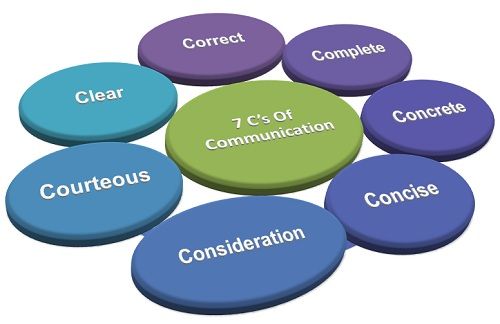
7 C’s of Communication
7 C’s of Communication
Definition: The 7
C’s of Communication is a checklist that helps to improve the
professional communication skills and increases the chance that the message
will be understood in exactly the same way as it was intended.
To have effective communication, one should
keep the following 7 C’s of communication in mind:

1. Clear: The message should be clear and easily understandable to
the recipient. The purpose of the communication should be clear to sender then
only the receiver will be sure about it. The message should emphasize on a
single goal at a time and shall not cover several ideas in a single sentence.
2. Correct: The message should be correct, i.e. a correct language
should be used, and the sender must ensure that there is no grammatical and
spelling mistakes. Also, the message should be exact and well-timed. The
correct messages have a greater impact on the receiver and at the same time,
the morale of the sender increases with the accurate message.
3. Complete: The message should be complete, i.e. it must include all
the relevant information as required by the intended audience. The complete
information gives answers to all the questions of the receivers and helps in
better decision-making by the recipient.
4. Concrete: The communication should be concrete, which
means the message should be clear and particularly such that no room for
misinterpretation is left. All the facts and figures should be clearly
mentioned in a message so as to substantiate to whatever the sender is saying.
5. Concise: The message should be precise and to the point. The sender
should avoid the lengthy sentences and try to convey the subject matter in the
least possible words. The short and brief message is more comprehensive and
helps in retaining the receiver’s attention.
6. Consideration: The sender must take into consideration the
receiver’s opinions, knowledge, mindset, background, etc. in order to have an
effective communication. In order to communicate, the sender must relate to the
target recipient and be involved.
7. Courteous: It implies that the sender must take into consideration
both the feelings and viewpoints of the receiver such that the message is
positive and focused at the audience. The message should not be biased and must
include the terms that show respect for the recipient.


Comments
Post a Comment